Showing posts with label Theologian. Show all posts

Sunday, February 14, 2010

William Wrede

Georg Friedrich Eduard William Wrede (10 May 1859 – 23 November 1906) was a German Lutheran theologian.

Wrede was born at Bücken in Hannover. He became an associate professor at Breslau in 1893, and full professor in 1896. He died in office in 1906.

He became famous for his investigation of the Messianic Secret theme in the Gospel of Mark. He suggested that this was a literary and apologetic device by which early Christians could explain away the absence of any clear claim to be the Messiah. According to Wrede, the solution devised by the author of the Mark Gospel was to imply that Jesus kept his messiahship secret to his inner group of supporters. He also wrote a crucial study of the Second Epistle to the Thessalonians, which argued for its inauthenticity.

In his work on Paul, Paulus, he argued that without Paul, Christianity would have basically become just another backwater Jewish sect that would have had little influence in later religious development. As a result, he concluded that Paul was "the second founder of Christianity."[1] He went so far as to separate Paul from his Jewish background, arguing that Paul was definitely influenced by certain Hellenistic concepts. As a result, his understanding of the flesh/spirit dualism within Paul parallels that of many others who understand flesh from a Hellenistic context where matter itself is inherently corrupted.

His work, and that of Albert Schweitzer himself mark the end of the First Quest or Old Quest into the historical Jesus. Schweitzer's 1906 book was called "The Quest of the Historical Jesus: A Critical Study of Its Progress from Reimarus to Wrede". See the Quest for the historical Jesus.

Tuesday, January 13, 2009

Theologian of The Day

Not exactly a theologian, but one worthy to be mentioned...

The English devotional writer, controversialist, and mystic William Law (1686-1761) wrote works on practical piety that are considered among the classics of English theology.

William Law was born in King's Cliffe, North-amptonshire, the son of a grocer and one of 11 children. In 1705 he was sent to Emmanuel College, Cambridge. He earned a bachelor of arts degree in 1708, was ordained in 1711, and became a fellow of Emmanuel in 1712. In 1713 Law was suspended from his fellowship for delivering a speech in which it appeared he supported the Stuart pretender to the throne rather than the future George I of Hanover. In 1714 at the accession of George I, he refused to take the oath of allegiance, becoming, in the nomenclature of the day, a nonjuror. As a result, for the rest of his life he occupied no benefice in the Church of England and appears to have officiated at no religious services.

In 1727 Law became tutor at Putney to the father of the eminent historian Edward Gibbon and was considered a respected member of the family circle. In 1740 Law returned to King's Cliffe, soon to be joined by Hester Gibbon, the aunt of the historian, and another lady of quality, Mrs. Hutchenson. Through their assistance Law was able to devote himself to study and charitable activities until his death. He set up schools, provided food for the poor, and became a spiritual adviser renowned as a man of singular compassion and simplicity.

Law's chief fame, however, rests on his writings. In an age when much theological thought was deeply affected by the rationalism of John Locke and Isaac Newton, Law became a vocal spokesman for the need to return to a religion of piety and feeling. As a result, Law entered into a number of controversies with leading thinkers of his day. In 1717 he attacked Bishop Hoadly's contention that the visible church and priesthood had no claim to divine authority. In 1723 a critique of Bernard Mandeville's Fable of the Bees appeared, in which Law defended morality against Mandeville's argument that man was motivated completely by self-interest. In 1731 Law published a forceful rejoinder to the deist Mathew Tindal, in which Law denied the total efficacy of reason.

It is, however, Law's A Serious Call to a Devout and Holy Life (1728) which is regarded as his most enduring work. Emphasizing the need to be a Christian in spirit and deed as well as in name, the tract is an uncompromising demand for continual and heartfelt Christian dedication. Beautifully written, this work had a tremendous impact in its day, carrying its message to such diverse 18th-century figures as Dr. Samuel Johnson, John Wesley, and Edward Gibbon.

Through his concern for the religion of the heart and through the reading of mystical literature, Law in his later years developed a unique and personal mysticism. Dwelling on the "inner spirit" of Christ within man, his thought became less orthodox and his conception of religion less formal, though he never left the Church of England.


Law receives comprehensive treatment in J. H. Overton, William Law, Non Juror and Mystic (1881). There is a skeptical but sympathetic account of him in Leslie Stephen, History of English Thought in the 18th Century (2 vols., 1876). See also W. R. Inge, Studies of English Mystics (1906); Stephen Hobhouse, William Law and Eighteenth Century Quakerism (1927); and J. B. Green, John Wesley and William Law (1945).

Friday, January 9, 2009

Theologian of The Day : A Joshua Harris of his day...

William Gouge

(1575-1653) "was born in Stratford-Bow Middlesex County, England. Educated in Paul's School, London, Felstad in Essex, and at Eton School. He graduated from King's College, Cambridge, followed by a brilliant teaching career there.

Following his ordination at 32 years of age, he ministered at Blackfriars Church, London for 45 years. In addition to his great success as a pastor, his mid-week expository lectures at Blackfriars drew increasingly larger crowds. Spirituality and scholarship made his career at Cambridge, his pastoral work and his writings unique. He was renowned as "the father of the London Divines and the oracle of his time." In 1643 he was made a member of the Westminster Assembly of Divines by vote of Parliament. His primary works include his Commentary on Hebrews, The Whole Armour of God, and Domestic Duties."

Of Domesticall Duties and the family
Of Domesticall Duties (1622) was a popular and thorough text of its time discussing family life.[11][12] It argued that husband and wife should be partners in marriage,[13] and was an important conduct book of its period, running to later editions.[14][15]

Gouge himself was father to 13 children. His wife Elizabeth, nee Calton and an orphan, died shortly after the birth of her thirteenth child. They had married in the early 1600s, in effect by arrangement, when Gouge was put under pressure by his family.[16][17][3] Elizabeth had been brought up by the wife of an Essex minister, John Huckle, and was eulogised after her death.[18]

His teaching on female submission was resisted even by his own congregation.[19] He considered adultery equally bad in both genders, and encouraged love matches.[20]

Theologian of The Day


Herman Bavinck (1854-1921), a Dutch Reformed theologian, was a contemporary of Abraham Kuyper and B. B. Warfield, both of whom he knew well. He graduated magna cum laude in 1880 from Leiden with a double major in Systematic Theology and Old Testament. His doctoral dissertation was on the concept of the State in Zwingli's theology. Bavinck taught at the Theological Seminary in Kampen, Holland - where he also pastored - before accepting the position of professor at the Free University of Amsterdam. He is best known for his magnum opus, Reformed Dogmatics (Gereformeerde Dogmatiek, in 4 volumes). Bavinck is one of the most balanced and solidly Reformed theologians Holland ever produced.

Bavinck breaks down the Doctrine of God into 7 categories: God's Incomprehensibility, God's Knowability, God's Names, God's Incommunicable Attributes, God's Communicable Attributes, The Holy Trinity, and God's Counsel. Each of these of course is further subdivided in a logical format. Note that in the Dutch original, God's Names came after God's Incommunicable Attributes, and the editor does not give any rational for the change. The Doctrine of God is translated and edited by William Hendriksen, who of course gave us the red colour NT Commentary (completed by Kistemaker after his death).
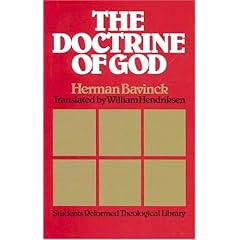
Bavinck introduced the notion of organic inspiration of the Scriptures and also developed a solution to the infra/supralapsarian conundrum. Although Bavinck passed on in 1921, he remains a powerful force in Reformed theology. Several important Reformed theologians owe large debts to him, including Cornelius Van Til and Louis Berkhof.

From http://hermanbavinck.org/biography/

QUEEN OF THE SCIENCES

Theologians tend to be influenced by fashionable trends. Modern academic theologians try to avoid basing their arguments on the distinctive claims of Scripture. Although Bavinck was well versed in the modernist trends of his time, he did not succumb to their lure. He was a theologian of the Word. And what he said about theology should serve as a reminder for today’s academic theologians. In 1899 he stated in a speech that a doctor in theology is a servant of the church. His work consists of searching the Scriptures defending its truth, the training of men aspiring to become pastors, the perfecting of the saints in the building of the body of Christ. He wholeheartedly embraced the historic Reformed position: the Sacred Scripture is the source of theology. The Lord spoken! This is the starting point of all theology!

Bavinck was a Reformed theologian, whose dogmatics were rooted in the 16th century Reformation. According to him, no confession was as Biblical, broad, and truly catholic as the one of the historic Reformed churches. Theology is more than a discussion of church, religion, etc. In theology the church discovers her treasures. Without theology the church cannot exist. Bavinck was convinced that the Reformed churches needed an independent Reformed theology. Because, he said, “a church without a theology is a body without a head.” But without faith theology cannot exist.

For Bavinck, theology was still the queen of the sciences. He fiercely resisted the secularization of theology, which was already an issue in his time. Theology is born in the faith of the church and has the knowledge of God as its content. The fear of the Lord is its key element. “Theology is speaking about God, through God and to God.” It is a positive science, the knowledge of God in the face of Christ the Sent One of the Father. Religion and theology are like Mary and Martha, both are needed in the household of faith. Without the knowledge of God, there is no real life. This knowledge must be continually broadened and made clearer, and if necessary, cleansed through the Word. For this task theology is God’s ordained instrument.

The study of theology is sacred work, a priestly service in the house of the Lord, a consecration of heart and mind to the glory of God. The church’s and our personal confession of faith is thoroughly theological - a confession of the Father, the Son, and the Holy Spirit. Doctrine, therefore, is nothing but the unfolding of what God has revealed to us in His Triune Name and sealed in baptism. Whether he addressed theologians or politicians, Bavinck was always the theologian. For example, at the 1891 Christian Social Congress, he spoke about the general Biblical principles and their practical implications, which can offer a solution for social questions.

PREACH THE WORD

Bavinck confessed that the sermon was the most important part of the worship service. The preaching of the Word of God is the determinative mark of the church by which each congregation is formed. The sacraments are subordinate to the Word. They are without value on their own. They are nothing less and nothing more than the visible Word. Protestant churches are the churches of the Word. Jesus rules through the Word and the Spirit, and especially through the spoken word. Bavinck had little patience for pastors who did not study. The congregation has the right to hear the Word of God explained. When the pulpit wants to regain its power, the preacher must be a student of the Word, search it in all its riches and depth, in its unity and diversity.

Bavinck said that we know so little about the Scripture. There are still so many hidden treasures never enjoyed as yet by the congregation. Pastors are treasure hunters. The pastor who dares to come with a sermon without diligent and proper preparation has not trembled before the majesty of the Word! In other words: The study of the Word is the pastor’s primary duty. Congregations and pastors do not forget Bavinck’s message to the churches! Congregations should not be satisfied with sermonettes, stories and anecdotes. Bavinck urges pastors to hasten, so that when the Son appears, we can say to Him that we have kept His Word and have not denied His name, and that we know Him and the power of His resurrection and the fellowship of His suffering.