Showing posts with label Books. Show all posts

Thursday, September 22, 2011

Review of Alexander’s From Eden to the New Jerusalem


http://jimhamilton.info/2010/08/06/review-of-alexanders-from-eden-to-the-new-jerusalem/


T. Desmond Alexander. From Eden to the New Jerusalem: An Introduction to Biblical Theology. Grand Rapids: Kregel, 2009 (Nottingham, England: InterVarsity, 2008). 208pp. 978-0825420153. $19.99 Paperback. Published in The Southern Baptist Journal of Theology 14.2 (2010), 94-95.
T. Desmond Alexander is well known to those interested in biblical theology. Among his publications are key books on the Messiah in the OT (The Servant King) and a theological introduction to the Pentateuch (From Paradise to the Promised Land), along with significant essays on the genealogies, on royal ideology, and on the seed theme in Genesis. Together with Brian Rosner, D. A. Carson, and Graeme Goldsworthy, he edited the New Dictionary of Biblical Theology. The book under review here is the best brief survey of biblical theology to be found anywhere. In 200 pages Alexander instructively presents the major themes in and contours of the Bible’s plot.
He sets out to probe God’s revelation of the world’s meta-story in the Bible for answers to two questions: why does the earth exist and what is the purpose of human life? Alexander shows that the earth is God’s cosmic temple, and humanity’s purpose is to rule in God’s stead and minister in his temple. We are priest-kings in a cosmic temple.
Alexander first examines the gardens that frame the Bible’s big story in the matching portraits of Genesis 1–3 and Revelation 21–22. He contends, with Beale and others, that the earth was designed as a divine residence, and that the tabernacle and temple are literally “microcosms”—depictions of the universe in miniature. As such the tabernacle and temple are symbols of what the world is to be, matching the depiction of the new Jerusalem as a temple-city in Revelation 21–22 and the Garden of Eden as a divine sanctuary in Genesis 2–3. Adam’s role, and Israel’s, was to broaden the boundaries of the dwelling place of God, and that task has been given to the church, which is now God’s temple where the Spirit dwells. Everyone interested in understanding the Bible will want to study the compelling evidence presented for these concepts.
Alexander then explores the role of Adam and Eve as God’s viceroys, priest-kings whose duty it was to “extend God’s temple and kingdom throughout the earth” (78). Instead they betrayed God, sided with his enemy, forfeited their priestly status, and gave the serpent control over the earth. God sets up the theocracy of Israel and later the kingdom of God in the church to reestablish his sovereignty in the world. From Abraham and Melchizedek through the nation of Israel on to Jesus, Alexander traces the depiction of God’s priest-king. The exodus from Egypt is a picture of rescue from the consequences of sin and the establishment of God’s rule and presence, which amounts to a transfer of God’s people from one kingdom to another. Jesus is the fulfillment of Old Testament expectations for a priest-king, and he accomplishes a new and greater exodus.
This new exodus involves the defeat of the ancient serpent, cursed in Genesis 3:15. The conquest is accomplished by the slaying of the new Passover Lamb, Jesus, who was then raised from the dead. He crushed the serpent’s head, accomplishing atonement, purification, and sanctification. God’s people are set right before him (justified), cleansed of their sin (purified), and set apart for him (sanctified). We look forward to the harmonious relationships between creatures and creation in the glorious eschatological future promised in the Bible. This hope, based on our understanding of the plot and purpose inherent in the Bible’s big story, guards us against the new epidemic of “affluenza,” which rests like a spell cast by the sorceress-harlot Babylon on Western society.
This is a remarkable book. In short compass Alexander is wide ranging and thorough, detailed and stimulating. From Eden to the New Jerusalem is a book on biblical theology that will benefit pastors and students, and it deserves a wide reading in the academy as well, especially for the ways it balances prevailing atomistic approaches with a big picture overview. The smaller episodes and characters within the big story cannot be understood apart from whole, and I know of no better brief sketch of the whole picture than this one.
Related: Andy Naselli recently interviewed Desi Alexander on Biblical Theology at Between Two Worlds.

Sunday, September 4, 2011

A great list...

http://thegospelcoalition.org/book-reviews/review/help_in_gospel-centered_bible_reading

Help in Gospel-Centered Bible Reading

Dane Ortlund | Review by: Dane Ortlund


Sometimes we can read the Bible while still missing its overarching perspective with Jesus as the center. These books will help you develop and maintain that Christ-centered focus. 
Authors to read for further study on gospel-centered hermeneutics: 
* = entry level
** = intermediate level
*** = advanced level 
T. Desmond Alexander
*The Servant King: The Bible’s Portrait of the Messiah. Regent College Press, 2003. 172 pp.

*From Eden to the New Jerusalem: An Introduction to Biblical Theology. Kregel, 2009. 208 pp. 
G. K. Beale
***A New Testament Biblical Theology: Transformation of the Old Testament in the New. Baker, 2011. 992 pp.

**“The Eschatological Conception of New Testament Theology.” In The Reader Must Understand: Eschatology in Bible and Theology. Edited by K. E Browner and M. W. Elliot. InterVarsity, 1997. 60 pp. 
D. A. Carson
*The God Who Is There: Finding Your Place in the Story. Baker, 2010. 240 pp. 
Bryan Chapell
**Christ-Centered Preaching: Redeeming the Expository Sermon. 2d ed. Baker, 2005. 400 pp. Note especially chapters 10 and 11. 
Roy Ciampa
**“The History of Redemption.” In Central Themes in Biblical Theology: Mapping Unity in Diversity. Edited by Scott J. Hafemann and Paul R. House. Baker, 2007. 50 pp. 
Edmund Clowney
**Preaching Christ in All of Scripture. Crossway, 2003. 192 pp.

**The Unfolding Mystery: Discovering Christ in the Old Testament. Presbyterian & Reformed, 1991. 208 pp. 
Stephen Dempster
**Dominion and Dynasty: A Biblical Theology of the Hebrew Bible. InterVarsity: 2003. 267 pp. 
William Dumbrell
**The End of the Beginning: Revelation 21–22 and the Old Testament. Wipf & Stock:2001. 216 pp. 
Graeme Goldsworthy
*According to Plan: The Unfolding Revelation of God in the Bible. InterVarsity, 2002. 251 pp.

**The Goldsworthy Trilogy (Gospel and KingdomGospel and WisdomThe Gospel in Revelation). Paternoster, 2001. 586 pp. (esp. Gospel and Kingdom)

***Gospel-Centered Hermeneutics: Foundations and Principles of Evangelical Biblical Interpretation. InterVarsity, 2007. 341 pp.

**Preaching the Whole Bible as Christian Scripture: The Application of Biblical Theology to Expository Preaching. Eerdmans, 2000. 287 pp. 
Sidney Greidanus
**Preaching Christ from the Old Testament: A Contemporary Hermeneutical Method. Eerdmans, 1999. 392 pp. 
Dennis E. Johnson
**Him We Proclaim: Preaching Christ from All the Scriptures. Presbyterian & Reformed, 2007. 494 pp. 
Sally Lloyd-Jones 
*The Jesus Storybook Bible: Every Story Whispers His Name. Zondervan, 2007. 352 pp. 
Vaughan Roberts
*God’s Big Picture: Tracing the Storyline of the Bible. InterVarsity, 2003. 160 pp. 
O. Palmer Robertson
**The Christ of the Covenants. Presbyterian & Reformed, 1981. 308 pp. 
Colin Smith
*The Plan. TGC Booklets. Crossway, 2011. 30 pp. 
Michael Williams 
*Far as the Curse Is Found: The Covenant Story of Redemption. Presbyterian & Reformed, 2005. 319 pp. 
Christopher J. H. Wright
**Knowing Jesus through the Old Testament. InterVarsity, 1992. 256 pp.
Dane Ortlund (PhD, Wheaton College) is senior editor of Bible at Crossway Books in Wheaton, Illinois, where he lives with his wife, Stacey, and two boys. Dane blogs regularly at Strawberry-Rhubarb Theology. He is the author of A New Inner Relish: Christian Motivation in the Thought of Jonathan Edwards

Thursday, July 7, 2011

30 Books Every Christian Should Read

http://www.theblazingcenter.com/30-books-every-christian-should-read

30 Books Every Christian Should Read

I believe that reading books written by other, wiser Christians is one of the most effective ways to grow as a Christian. But with millions of books available and thousands more being written every year, how can you know which ones to read? In order to help you, I compiled a list of thirty books I think that every Christian should read. This list isn’t exhaustive by any means, and there are many others that should be on the list, but this should get you started.
Heaven by Randy Alcorn – Given the fact that we will spend eternity in heaven, we should know at least something of what it will be like. Randy Alcorn answers many common questions about heaven and paints a biblical picture of what eternity will be like.
Valley of Vision: A collection of Puritan Prayers & Devotions by Arthur Bennett – These Puritan prayers will fuel your personal prayer life with their rich view of God.
The Discipline of Grace: God’s Role and Our Role in the Pursuit of Holiness by Jerry Bridges – What is the connection between God’s grace and our personal pursuit of holiness? Jerry Bidges answers that question.
Trusting God: Even When Life Hurts by Jerry Bridges – All of us will go through trials of some sort, and this book will equip you to trust God in even the most difficult circumstances.
Rare Jewel of Christian Contentment by Jeremiah Burroughs – If you find yourself struggling with contentment in your job, marriage, or any other situation, this book is for you.
Spurgeon: A New Biography by Arnold Dallimore – Charles Spurgeon was a giant of the Christian faith, and this biography will stir you to love God, pursue God, and trust in God like Spurgeon.
The Message of the Old Testament: Promises Made by Mark Dever – The Old Testament can be a very confusing place. In this book, Mark Dever provides a short, yet very helpful overview of every book in the Old Testament, making this a key tool for your personal Bible study.
The Message of the New Testament: Promises Kept by Mark Dever – This is another helpful Bible study tool in which Mark Dever provides a short overview of every book in the New Testament.
The Gospel and Personal Evangelism by Mark Dever – Who should evangelize? What should we say when we evangelize? Mark Dever answers these questions and more in this short book.
Just Do Something: How to Make a Decision Without Dreams, Visions, Fleeces, Open Doors, Random Bible Verses, Casting Lots, Liver Shivers, Writing in the Sky, etc. by Kevin DeYoung – How can you know God’s will for your life? Find out by reading this book.
What Is the Gospel? (9Marks) by Greg Gilbert – We absolutely cannot afford to get the gospel wrong, and this book will help you have clarity on the various facets of the gospel.
According to Plan: The Unfolding Revelation of God in the Bible by Graeme Goldsworthy – The Bible is more than just a series of books, it’s the story of what God is doing in history. Get an overview of that story in this book.

Systematic Theology: An Introduction to Biblical Doctrine by Wayne Grudem – This is the most helpful theological reference I own. If you have questions about demons, the Bible, church government, the Holy Spirit, or just about anything else, you can find the answer here.
God, Marriage, and Family: Rebuilding the Biblical Foundation by Andreas Kostenberger – The institutions of marriage and family are under attack in our culture. This book will help you have a biblical understanding of many different issues, such as divorce, homosexuality, birth control, and the role of men and women.
Humility: True Greatness by C.J. Mahaney – There are few things more important to God than humility. If you want to grow in humility, read this book.
Living the Cross Centered Life: Keeping the Gospel the Main Thing by C.J. Mahaney – How can we live in the joy and freedom of God? How can we grow as Christians? By keeping the gospel as the central thing in our Christian lives.

Overcoming Sin and Temptation by John Owen – This book is a tough read, but it’s really valuable. John Owen examines the workings of sin and shows us how to defeat sin and temptation.
Knowing God by J.I. Packer – If you want to know what God is like, this is your book. J.I. Packer examines the various attributes of God, such as his holiness, his love, his justice, and his eternity.
Desiring God: Meditations of a Christian Hedonist by John Piper – There are few books that have my understanding of what it means to love God than this one. Loving God is more than just duty, it is delight.
What’s the Difference?: Manhood and Womanhood Defined According to the Bible by John Piper – Men and women are given specific roles by God. In this very short book, John Piper explains those roles from a biblical perspective.
Finally Alive by John Piper – The phrase “born again” has been blurred and even distorted in our culture. In this book John Piper explains the real meaning of what it means to be born again.
God Is the Gospel: Meditations on God’s Love as the Gift of Himself by John Piper – What is the gospel really about? The gospel is not primarily about having our sins forgiven, it is primarily about getting God himself.
Love That Lasts: When Marriage Meets Grace by Gary and Betsy Ricucci – Every married couple should read this book multiple times. In it you will find biblical principles and practices for establishing a healthy, romantic, God-honoring marriage.
The Holiness of God by R.C. Sproul – This is not a safe book. If you read it you will find yourself trembling before the holiness of God.
Chosen by God by R.C. Sproul – Have you ever struggled with the doctrine of election? In this book, R.C. Sproul dispels common myths about election and shows how it is actually a very glorious doctrine.
The Cross of Christ by John Stott – The cross is the centerpiece of Christianity, and as you read this book you will find yourself amazed at what God has done through the cross and incredibly grateful for the cross.
Shepherding a Child’s Heart by Tedd Tripp – As parents it’s easy to simply want our children to behave. However, if we’re going to honor God we must also get to the heart of obedience.
A Gospel Primer for Christians: Learning to See the Glories of God’s Love by Milton Vincent – This little book is a wonderful devotional tool, providing short meditations on the gospel in both prose and poetry. It’s a book that can be read many times.
When People Are Big and God Is Small: Overcoming Peer Pressure, Codependency, and the Fear of Man (Resources for Changing Lives) by Ed Welch – Every Christian struggles with the fear of man, and many times it is a massive struggle. This book is a helpful tool for overcoming the sin of the fear of man.
Spiritual Disciplines for the Christian Life by Donald Whitney – A rich Christian life doesn’t come without discipline, and in this book Donald Whitney examines many different disciplines for the Christian life, such as Bible reading, prayer, journaling, fasting, and solitude.

Sunday, March 21, 2010

Wishlist

The Galatians: The Charter of Christian Liberty by Merrill C. Tenney

Revelation: Four Views: A Parallel Commentary (Hardcover) by Steve Gregg

The Theology of the Book of Revelation (New Testament Theology) by Richard Bauckham

The Gospel according to John (Pillar New Testament Commentary) (Hardcover) ~ D. A. Carson (Author, Series Editor)

Sunday, February 21, 2010

The Radical Disciple (John Stott)

Preface: Disciples or Christians?


Let me explain and justify the title of this book, The Radical Disciple.


First, why ‘disciple’?


It comes as a surprise to many people to discover that the followers of Jesus Christ are called ‘Christian’ only three times in the New Testament.


The most significant occurrence is Luke’s comment that it was in Syrian Antioch that Jesus’ disciples were first called ‘Christians’ (Acts 11:26). Antioch was known to be an international community. Consequently its church was an international community too, and it was appropriate that its members were called ‘Christians’ in order to indicate that their ethnic differences were overcome by their common allegiance to Christ.


The other two occurrences of the word ‘Christian’ supply evidence that it was beginning to come into common currency. So when Paul was on trial before King Agrippa and challenged him directly, Agrippa cried out to Paul, ‘Do you think that in such a short time you can persuade me to be a Christian?’ (Acts 26:28).


Then the apostle Peter, whose first letter was written against the background of growing persecution, found it necessary to distinguish between those who suffered ‘as a criminal’ and those who suffered ‘as a Christian’ (1 Peter 4:16); that is, because they belonged to Christ. Both words (Christian and disciple) imply a relationship with Jesus, although perhaps ‘disciple’ is the stronger of the two because it inevitably implies the relationship of pupil to teacher. During his three years of public ministry the Twelve were disciples before they were apostles, and as disciples they were under the instruction of their teacher and lord.


One wishes in some ways that the word ‘disciple’ had continued into the following centuries, so that Christians were self-consciously disciples of Jesus, and took seriously their responsibility to be ‘under discipline’.


My concern in this book is that we who claim to be disciples of the Lord Jesus will not provoke him to say again: ‘Why do you call me, “Lord, Lord,” and do not do what I say?’ (Luke 6:46). For genuine discipleship is wholehearted discipleship, and this is where my next word comes in.


So, secondly, why ‘radical’? Since this is the adjective I am using to describe our discipleship, it is important to indicate the sense in which I am using it.


The English word ‘radical’ is derived from the Latin word radix, a root. Originally it seems to have been applied as a political label to people like the nineteenth-century politician William Cobbett and their extreme, liberal and reformist views. But from this it came to be applied generally to those whose opinions went to the roots and who were thoroughgoing in their commitment.


We are now ready to put the noun and the adjective together and to ask our third question, namely why ‘radical disciple’? The answer is obvious. There are different levels of commitment in the Christian community. Jesus himself illustrated this in what happened to the seeds he describes in the Parable of the Sower. The difference between the seeds lay in the kind of soil which received them. Of the seed sown on rocky soil Jesus said, ‘It had no root.’


Our common way of avoiding radical discipleship is to be selective; choosing those areas in which commitment suits us and staying away from those areas in which it will be costly. But because Jesus is Lord, we have no right to pick and choose the areas in which we will submit to his authority.


Jesus is worthy to receive

Honour and power divine.

And blessings more than we can give

Be Lord for ever thine.


So my purpose in this book is to consider eight characteristics of Christian discipleship which are often neglected and yet deserve to be taken seriously.

Unbiblical & lousy books that give Christianity a bad name

http://www.amazon.com/Unbiblical-amp-lousy-books-that-give-Christianity-a-bad-name/lm/RZJR57SZP6U53/ref=cm_lm_byauthor_title_full

Thought that this list is pretty interesting... ;-)

Saturday, February 6, 2010

Excerpted from Dug Down Deep by Joshua Harris

Excerpt
1
MY RUMSPRINGA
"We're all theologians. The question is
whether what we know about God is true."

IT'S STRANGE TO SEE an Amish girl drunk. The pairing of a bonnet and a can of beer is awkward. If she were stumbling along with a jug of moonshine, it would at least match her long, dowdy dress. But right now she can't worry about that. She is flat-out wasted.

Welcome to rumspringa.

The Amish, people who belong to a Christian religious sect with roots in Europe, practice a radical form of separation from the modern world. They live and dress with simplicity. Amish women wear bonnets and long, old-fashioned dresses and never touch makeup. The men wear wide-rimmed straw hats, sport bowl cuts, and grow chin curtains—full beards with the mustaches shaved off.

My wife, Shannon, sometimes says she wants to be Amish, but I know this isn't true. Shannon entertains her Amish fantasy when life feels too complicated or when she's tired of doing laundry. She thinks life would be easier if she had only two dresses to choose from and both looked the same. I tell her that if she ever tried to be Amish, she would buy a pair of jeans and ditch her head covering about ten minutes into the experiment. Besides, she would never let me grow a beard like that.

Once Shannon and her girlfriend Shelley drove to Lancaster, Pennsylvania, for a weekend of furniture and quilt shopping in Amish country. They stayed at a bed-and-breakfast located next door to an Amish farm. One morning Shannon struck up a conversation with the inn's owner, who had lived among the Amish his entire life. She asked him questions, hoping for romantic details about the simple, buggy-driven life. But instead he complained about having to pick up beer cans every weekend.

Beer cans?

"Yes," he said, "the Amish kids leave them everywhere." That's when he told her about rumspringa. The Amish believe that before a young person chooses to commit to the Amish church as an adult, he or she should have the chance to freely explore the forbidden delights of the outside world. So at age sixteen everything changes for Amish teenagers. They go from milking cows and singing hymns to living like debauched rock stars.

In the Pennsylvania Dutch language, rumspringa literally means "running around." It's a season of doing anything and everything you want with zero rules. During this time—which can last from a few months to several years—all the restrictions of the Amish church are lifted. Teens are free to shop at malls, have sex, wear makeup, play video games, do drugs, use cell phones, dress however they want, and buy and drive cars. But what they seem to enjoy most during rumspringa is gathering at someone's barn, blasting music, and then drinking themselves into the ground. Every weekend, the man told Shannon, he had to clean up beer cans littered around his property following the raucous, all-night Amish parties.

When Shannon came home from her Lancaster weekend, her Amish aspirations had diminished considerably. The picture of cute little Amish girls binge drinking took the sheen off her idealistic vision of Amish life. We completed her disillusionment when we rented a documentary about the rite of rumspringa called Devil's Playground. Filmmaker Lucy Walker spent three years befriending, interviewing, and filming Amish teens as they explored the outside world. That's where we saw the drunk Amish girl tripping along at a barn party. We learned that most girls continue to dress Amish even as they party—as though their clothes are a lifeline back to safety while they explore life on the wild side.

In the documentary Faron, an outgoing, skinny eighteen-year-old sells and is addicted to the drug crystal meth. After Faron is busted by the cops, he turns in rival drug dealers. When his life is threatened, Faron moves back to his parents' home and tries to start over. The Amish faith is a good religion, he says. He wants to be Amish, but his old habits keep tugging on him.

A girl named Velda struggles with depression. During rumspringa she finds the partying empty, but after joining the church she can't imagine living the rest of her life as an Amish woman. "God talks to me in one ear, Satan in the other," Velda says. "Part of me wants to be my like my parents, but the other part wants the jeans, the haircut, to do what I want to do."1 When she fails to convince her Amish fiancé to leave the church with her, she breaks off her engagement a month before the wedding and leaves the Amish faith for good. As a result Velda is shunned by her family and the entire community. Alone but determined, she begins to attend college.

Velda's story is the exception. Eighty to 90 percent of Amish teens decide to return to the Amish church after rumspringa.2 At one point in the film, Faron insightfully comments that rumspringa is like a vaccination for Amish teens. They binge on all the worst aspects of the modern world long enough to make themselves sick of it. Then, weary and disgusted, they turn back to the comforting, familiar, and safe world of Amish life.

But as I watched, I wondered, What are they really going back to? Are they choosing God or just a safe and simple way of life?
-
I know what it means to wrestle with questions of faith. I know what it's like for faith to be so mixed up with family tradition that it's hard to distinguish between a genuine knowledge of God and comfort in a familiar way of life.

I grew up in an evangelical Christian family. One that was on the more conservative end of the spectrum. I'm the oldest of seven children. Our parents homeschooled us, raised us without television, and believed that oldfashioned courtship was better than modern dating. Friends in our neighborhood probably thought our family was Amish, but that's only because they didn't know some of the really conservative Christian homeschool families. The truth was that our family was more culturally liberal than many homeschoolers. We watched movies, could listen to rock music (as long as it was Christian or the Beatles), and were allowed to have Star Wars and Transformers toys.

But even so, during high school I bucked my parents' restrictions. That's not to say my spiritual waywardness was very shocking. I doubt Amish kids would be impressed by my teenage dabbling in worldly pleasure. I never did drugs. Never got drunk. The worst things I ever did were to steal porn magazines, sneak out of the house at night with a kid from church, and date various girls behind my parents' backs. Although my rebellion was tame in comparison, it was never virtue that held me back from sin. It was lack of opportunity. I shudder to think what I would have done with a parent-sanctioned
season of rumspringa.

The bottom line is that my parents' faith wasn't really my faith. I knew how to work the system, I knew the Christian lingo, but my heart wasn't in it. My heart was set on enjoying the moment.

Recently a friend of mine met someone who knew me in early high school. "What did she remember about me?" I asked.

"She said you were girl crazy, full of yourself, and immature," my friend told me.

Yeah, she knew me, I thought. It wasn't nice to hear, but I couldn't argue. I didn't know or fear God. I didn't have any driving desire to know him.

For me, the Christian faith was more about a set of moral standards than belief and trust in Jesus Christ.
-
During my early twenties I went through a phase of blaming the church I had attended in high school for all my spiritual deficiencies. Evangelical megachurches make good punching bags.

My reasoning went something like this: I was spiritually shallow because the pastors' teaching had been shallow. I wasn't fully engaged because they hadn't done enough to grab my attention. I was a hypocrite because everyone else had been a hypocrite. I didn't know God because they hadn't provided enough programs. Or they hadn't provided the right programs. Or maybe they'd had too many programs.

All I knew was that it was someone else's fault.

Blaming the church for our problems is second only to the popular and easy course of blaming our parents for everything that's wrong with us. But the older I get, the less I do of both. I hope that's partly due to the wisdom that comes with age. But I'm sure it's also because I am now both a parent and a pastor. Suddenly I have a lot more sympathy for my dad and mom and the pastors at my old church. Funny how that works, isn't it?

At the church where I now pastor (which I love), some young adults remind me of myself when I was in high school. They are church kids who know so much about Christian religion and yet so little about God. Some are passive, completely ambivalent toward spiritual things. Others are actively straying from their faith—ticked off about their parents' authority, bitter over a rule or guideline, and counting the minutes until they turn eighteen and can disappear. Others aren't going anywhere, but they stay just to go
through the motions. For them, church is a social group.

It's strange being on the other side now. When I pray for specific young men and women who are wandering from God, when I stand to preach and feel powerless to change a single heart, when I sit and counsel people and it seems nothing I can say will draw them away from sin, I remember the pastors from my teenage years. I realize they must have felt like this too. They must have prayed and cried over me. They must have labored over sermons with students like me in mind. I see now that they were doing the best they knew how. But a lot of the time, I wasn't listening.
-
During high school I spent most Sunday sermons doodling, passing notes, checking out girls, and wishing I were two years older and five inches taller so a redhead named Jenny would stop thinking of me as her "little brother." That never happened.

I mostly floated through grown-up church. Like a lot of teenagers in evangelical churches, I found my sense of identity and community in the parallel universe of the youth ministry. Our youth group was geared to being loud, fast paced, and fun. It was modeled on the massive and influential, seeker-sensitive Willow Creek Community Church located outside Chicago. The goal was simple: put on a show, get kids in the building, and let them see that Christians are cool, thus Jesus is cool. We had to prove that being a Christian is, contrary to popular opinion and even a few annoying passages
of the Bible, loads of fun. Admittedly it's not as much fun as partying and having sex but pretty fun nonetheless.

Every Wednesday night our group of four-hundred-plus students divided into teams. We competed against each other in games and won points by bringing guests. As a homeschooler, of course I was completely worthless in the "bring friends from school" category. So I tried to make up for that by working on the drama and video team. My buddy Matt and I wrote, performed, and directed skits to complement our youth pastor's messages. Unfortunately, our idea of complementing was to deliver skits that were not
even remotely connected to the message. The fact that Matt was a Brad Pitt look-alike assured that our skits were well received (at least by the girls).

The high point of my youth-group performing career came when the pastor found out I could dance and asked me to do a Michael Jackson impersonation. The album Bad had just come out. I bought it, learned all the dance moves, and then when I performed—how do I say this humbly?—I blew everyone away. I was bad (and I mean that in the good sense of the word bad ). The crowd went absolutely nuts. The music pulsed, and girls
were screaming and grabbing at me in mock adulation as I moonwalked and lip-synced my way through one of the most inane pop songs ever written. I loved every minute of it.

Looking back, I'm not real proud of that performance. I would feel better about my bad moment if the sermon that night had been about the depravity of man or something else that was even slightly related. But there was no connection. It had nothing to do with anything.

For me, dancing like Michael Jackson that night has come to embody my experience in a big, evangelical, seeker-oriented youth group. It was fun, it was entertaining, it was culturally savvy (at the time), and it had very little to do with God. Sad to say, I spent more time studying Michael's dance moves for that drama assignment than I was ever asked to invest in studying about God.

Of course, this was primarily my own fault. I was doing what I wanted to do. There were other kids in the youth group who were more mature and who grew more spiritually during their youth-group stint. And I don't doubt the good intentions of my youth pastor. He was trying to strike the balance between getting kids to attend and teaching them.
Maybe I wouldn't have been interested in youth group if it hadn't been packaged in fun and games and a good band. But I still wish someone had expected more of me—of all of us. Would I have listened? I can't know. But I do know that a clear vision of God and the power of his Word and the purpose of Jesus' life, death, and resurrection were lost on me in the midst of all the flash and fun.
-
There's a story in the Bible of a young king named Josiah, who lived about 640 years before Christ. I think Josiah could have related to me—being religious but ignorant of God. Josiah's generation had lost God's Word. And I don't mean that figuratively. They literally lost God's Word. It sounds ridiculous, but they essentially misplaced the Bible.

If you think about it, this was a pretty big deal. We're not talking about a pair of sunglasses or a set of keys. The Creator of the universe had communicated with mankind through the prophet Moses. He gave his law. He revealed what he was like and what he wanted. He told his people what it meant for them to be his people and how they were to live. All this was dutifully recorded on a scroll. Then this scroll, which was precious beyond measure, was stored in the holy temple. But later it was misplaced. No one
knows how. Maybe a clumsy priest dropped it and it rolled into a dark corner.

But here's the really sad thing: nobody noticed it was missing. No search was made. Nobody checked under the couch. It was gone and no one cared. For decades those who wore the label "God's people" actually had no communication with him. They wore their priestly robes, they carried on their traditions in their beautiful temple, and they taught their messages that were so wise, so insightful, so inspirational. But it was all a bunch of hot air—nothing but their own opinions. Empty ritual. Their robes were costumes, and their temple was an empty shell.

This story scares me because it shows that it's possible for a whole generation to go happily about the business of religion, all the while having lost a true knowledge of God.
-
When we talk about knowledge of God, we're talking about theology. Simply put, theology is the study of the nature of God—who he is and how he thinks and acts. But theology isn't high on many people's list of daily concerns.

My friend Curtis says that most people today think only of themselves. He calls this "me-ology." I guess that's true. I know it was true of me and still can be. It's a lot easier to be an expert on what I think and feel and want than to give myself to knowing an invisible, universe-creating God.

Others view theology as something only scholars or pastors should worry about. I used to think that way. I viewed theology as an excuse for all the intellectual types in the world to add homework to Christianity.

But I've learned that this isn't the case. Theology isn't for a certain group of people. In fact, it's impossible for anyone to escape theology. It's everywhere. All of us are constantly "doing" theology. In other words, all of us have some idea or opinion about what God is like. Oprah does theology. The person who says, "I can't believe in a God who sends people to hell" is doing theology.

We all have some level of knowledge. This knowledge can be much or little, informed or uninformed, true or false, but we all have some concept of God (even if it's that he doesn't exist). And we all base our lives on what we think God is like.

So when I was spinning around like Michael Jackson at youth group, I was a theologian. Even though I wasn't paying attention in church. Even though I wasn't very concerned with Jesus or pleasing him. Even though I was more preoccupied with my girlfriend and with being popular. Granted I was a really bad theologian—my thoughts about God were unclear and often ignorant. But I had a concept of God that directed how I lived.

I've come to learn that theology matters. And it matters not because we want a good grade on a test but because what we know about God shapes the way we think and live. What you believe about God's nature—what he is like, what he wants from you, and whether or not you will answer to him—affects every part of your life.

Theology matters, because if we get it wrong, then our whole life will be wrong.
-
I know the idea of "studying" God often rubs people the wrong way. It sounds cold and theoretical, as if God were a frog carcass to dissect in a lab or a set of ideas that we memorize like math proofs.

But studying God doesn't have to be like that. You can study him the way you study a sunset that leaves you speechless. You can study him the way a man studies the wife he passionately loves. Does anyone fault him for noting her every like and dislike? Is it clinical for him to desire to know the thoughts and longings of her heart? Or to want to hear her speak?

Knowledge doesn't have to be dry and lifeless. And when you think about it, exactly what is our alternative? Ignorance? Falsehood?

We're either building our lives on the reality of what God is truly like and what he's about, or we're basing our lives on our own imagination and misconceptions.

We're all theologians. The question is whether what we know about God is true.
-
In the days of King Josiah, theology was completely messed up. This isn't really surprising. People had lost God's words and then quickly forgot what the true God was like.

King Josiah was a contemporary of the prophet Jeremiah. People call Jeremiah the weeping prophet, and there was a lot to weep about in those days. "A horrible and shocking thing has happened in the land," Jeremiah said. "The prophets prophesy lies, the priests rule by their own authority, and my people love it this way" (Jeremiah 5:30–31, NIV).

As people learned to love their lies about God, they lost their ability to recognize his voice. "To whom can I speak and giving warning?" God asked. "Who will listen to me? Their ears are closed so they cannot hear. The word of the LORD is offensive to them; they find no pleasure in it" (Jeremiah 6:10, NIV).

People forgot God. They lost their taste for his words. They forgot what he had done for them, what he commanded of them, and what he threatened if they disobeyed. So they started inventing gods for themselves. They started borrowing ideas about God from the pagan cults. Their made-up gods let them live however they wanted. It was "me-ology" masquerading as theology.

The results were not pretty.

Messed-up theology leads to messed-up living. The nation of Judah resembled one of those skanky reality television shows where a houseful of barely dressed singles sleep around, stab each other in the back, and try to win cash. Immorality and injustice were everywhere. The rich trampled the poor. People replaced the worship of God with the worship of pagan deities that demanded religious orgies and child sacrifice. Every level of society, from marriage and the legal system to religion and politics, was corrupt.

The surprising part of Josiah's story is that in the midst of all the distortion and corruption, he chose to seek and obey God. And he did this as a young man (probably no older than his late teens or early twenties). Scripture gives this description of Josiah: "He did what was right in the eyes of the LORD and walked in all the ways of his father David, not turning aside to the right or to the left" (2 Kings 22:2, NIV).

The prophet Jeremiah called people to the same straight path of true theology and humble obedience:

Thus says the LORD:
"Stand by the roads, and look,
and ask for the ancient paths,
where the good way is; and walk in it,
and find rest for your souls." (Jeremiah 6:16)

In Jeremiah's words you see a description of King Josiah's life. His generation was rushing past him, flooding down the easy paths of man-made religion, injustice, and immorality.

They didn't stop to look for a different path.

They didn't pause to consider where the easy path ended.

They didn't ask if there was a better way.

But Josiah stopped. He stood at a crossroads, and he looked. And then he asked for something that an entire generation had neglected, even completely forgotten. He asked for the ancient paths.
-
What are the ancient paths? When the Old Testament prophet Jeremiah used the phrase, he was describing obedience to the Law of Moses. But today the ancient paths have been transformed by the coming of Jesus Christ. Now we see that those ancient paths ultimately led to Jesus. We have not only truth to obey but a person to trust in—a person who perfectly obeyed the Law and who died on the cross in our place.

But just as in the days of Jeremiah, the ancient paths still represent life based on a true knowledge of God—a God who is holy, a God who is just, a God who is full of mercy toward sinners. Walking in the ancient paths still means relating to God on his terms. It still means receiving and obeying his self-revelation with humility and awe.

Just as he did with Josiah and Jeremiah and every generation after them, God calls us to the ancient paths. He beckons us to return to theology that is true. He calls us, as Jeremiah called God's people, to recommit ourselves to orthodoxy.

The word orthodoxy literally means "right opinion." In the context of Christian faith, orthodoxy is shorthand for getting your opinion or thoughts about God right. It is teaching and beliefs based on the established, proven, cherished truths of the faith. These are the truths that don't budge. They're clearly taught in Scripture and affirmed in the historic creeds of the Christian faith:

There is one God who created all things.
God is triune: Father, Son, and Holy Spirit.
The Bible is God's inerrant word to humanity.
Jesus is the virgin-born, eternal Son of God.
Jesus died as a substitute for sinners so they could be forgiven.
Jesus rose from the dead.
Jesus will one day return to judge the world.

Orthodox beliefs are ones that genuine followers of Jesus have acknowledged from the beginning and then handed down through the ages. Take one of them away, and you're left with something less than historic Christian belief.
-
When I watched the documentary about the Amish rite of rumspringa, what stood out to me was the way the Amish teenagers processed the decision of whether or not to join the Amish church. With few exceptions the decision seemed to have very little to do with God. They weren't searching Scripture to see if what their church taught about the world, the human heart, and salvation was true. They weren't wrestling with theology. I'm not implying that the Amish don't have a genuine faith and trust in Jesus. But for the teens in
the documentary, the decision was mostly a matter of choosing a culture and a lifestyle. It gave them a sense of belonging. In some cases it gave them a steady job or allowed them to marry the person they wanted.

I wonder how many evangelical church kids are like the Amish in this regard. Many of us are not theologically informed. Truth about God doesn't define us and shape us. We have grown up in our own religious culture. And often this culture, with its own rituals and music and moral values, comes to represent Christianity far more than specific beliefs about God do.

Every new generation of Christians has to ask the question, what are we actually choosing when we choose to be Christians? Watching the stories of the Amish teenagers helped me realize that a return to orthodoxy has to be more than a return to a way of life or to cherished traditions. Of course the Christian faith leads to living in specific ways. And it does join us to a specific community. And it does involve tradition. All this is good. It's important. But it has to be more than tradition. It has to be about a person—the
historical and living person of Jesus Christ.

Orthodoxy matters because the Christian faith is not just a cultural tradition or moral code. Orthodoxy is the irreducible truths about God and his work in the world. Our faith is not just a state of mind, a mystical experience, or concepts on a page. Theology, doctrine, and orthodoxy matter because God is real, and he has acted in our world, and his actions have meaning today and for all eternity.
-
For many people, words like theology, doctrine, and orthodoxy are almost completely
meaningless. Maybe they're unappealing, even repellent.

Theology sounds stuffy.

Doctrine is something unkind people fight over.

And orthodoxy? Many Christians would have trouble saying what it is other than it calls to mind images of musty churches guarded by old men with comb-overs who hush and scold.

I can relate to that perspective. I've been there. But I've also discovered that my prejudice, my "theology allergy," was unfounded.

This book is the story of how I first glimpsed the beauty of Christian theology. These pages hold the journal entries of my own spiritual journey—a journey that led to the realization that sound doctrine is at the center of loving Jesus with passion and authenticity. I want to share how I learned that orthodoxy isn't just for old men but is for anyone who longs to behold a God who is bigger and more real and glorious than the human mind can imagine.

The irony of my story—and I suppose it often works this way—is that the very things I needed, even longed for in my relationship with God, were wrapped up in the very things I was so sure could do me no good. I didn't understand that such seemingly worn-out words as theology, doctrine, and orthodoxy were the pathway to the mysterious, awe-filled experience of truly knowing the living Jesus Christ.

They told the story of the Person I longed to know.


Excerpted from Dug Down Deep by Joshua Harris Copyright © 2010 by Joshua Harris. Excerpted by permission of Multnomah Books, a division of Random House, Inc. All rights reserved. No part of this excerpt may be reproduced or reprinted without permission in writing from the publisher.

Sunday, January 31, 2010

Devotion to God

The Practice of Godliness by Jerry Bridges pg29
Not only will a right concept of the fear of God cause us to worship God aright, it will also regulate our conduct. John Murray says: WHat or whom we worship determines our behavior" Albert Martin has said that the essential ingredients of the fear of God are
(1) correct concepts of the character of God
(2) a pervasive sense of the presence of God
(3) a constant awareness of our obligation to God

If we have some comprehension of Gods infinite holiness and his hatred of sin, coupled with this pervasive sense of God's presence in all of our actions,yes, even our thoughts, then such a fear of God must influence and regulate our conduct. Just as obedience to the Lord is an indication of our love for him, so is it also a proof of our fear of God. "You shall fear the Lord your God as long as you live by keeping all his decrees and commands..." (Deu 6:2)

--------------------------------------------------------

1 John 2:3-6: And by this we know that we have come to know him, if we keep his commandments. 4 Whoever says “I know him” but does not keep his commandments is a liar, and the truth is not in him, 5 but whoever keeps his word, in him truly the love of God is perfected. By this we may know that we are in him: 6 whoever says he abides in him ought to walk in the same way in which he walked.

Ex 15: 11 “Who is like you, O Lord, among the gods?
Who is like you, majestic in holiness,
awesome in glorious deeds, doing wonders?

ESV SB: Attribute of God: Holiness: God is absolutely and uniquely excellent above all creation (majesty) and without sin (purity). “And the four living creatures, each of them with six wings, are full of eyes all around and within, and day and night they never cease to say, ‘Holy, holy, holy, is the Lord God Almighty, who was and is and is to come!’” (Rev. 4:8; for “majestic holiness,” cf. Ex. 15:11; 1 Chron. 16:27–29; Isa. 57:15; for “moral holiness,” cf. Isa. 5:16; 6:1–8; Acts 3:14; Heb. 7:26). Implication: God should be feared and obeyed, and his people should earnestly pursue moral purity.

Tuesday, April 21, 2009

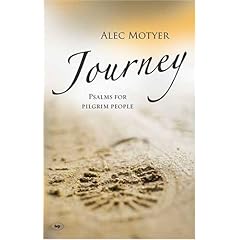
Journey (Alec Motyer)


Excerpts from the book...

Psalms for pilgrim people

Contents

Preface
1. Are you going up this year?
2. The pilgrims’ songbook
3. Psalm 120. The resident alien: Living in the unwelcome present
4. Psalm 121. The guarded pathway: In his world, under his shade
5. Psalm 122. The pilgrim in Zion: Home at last
6. Psalm 123. At the end of our tether: The Lord above
7. Psalm 124. Against overwhelming odds: The Lord alongside
8. Psalm 125. Keeping on keeping on: The encircling Lord
9. Psalms 126 – 131. A preview: The pilgrimage of the heart
10. Psalm 126. Instant coffee and stalactites: Living with God’s tensions
11. Psalm 127. Managing life’s cares: Busyness and restfulness
12. Psalm 128. Home at last: Fulfilment – present, guaranteed and ultimate
13. Psalm 129. The tonic of the backward look: How the past prepares us for the future
14. Psalm 130. Out of the depths into the light: The inside story
15. Psalm 131. At peace: Never stop being a child
16. Psalms 132 – 134. Take a break: Look back, look on
17. Psalm 132. The Lord in Zion: How he turns our plans upside down
18. Psalm 133. The family in Zion: The blessing of fellowship
19. Psalm 134. Worship in Zion: Safely home, richly blessed
20. Psalms 135 and 136. Singing the songs of homeland


1. Are you going up this year?

So often, the simplest way to understand something is the best.

What is possibly the loveliest single group of psalms in the whole collection, Psalms 120 – 134 describe themselves as ‘Songs of Ascents’. Like all the titles of individual psalms, this is to be taken seriously as a pointer to how the psalm in question is to be understood and used. The plural word ‘ascents’ could be what in Hebrew is called a ‘plural of magnitude’ – ‘the Great Ascent’, or it can be left as a simple plural, an ‘ascent’ that happened over and over again. Either way, it readily points to the journeys of pilgrims from all over the land ‘up’ to Jerusalem to keep the Feasts of the Lord.

This is the most direct interpretation of the title, and far less fanciful than some other suggestions that have been made. It also happens to be one that suits the psalms themselves very well, and, as we shall see, also suits the way in which they have been carefully edited into this small collection. In order to keep this in mind we will generally use the translation ‘Songs of the Ascent’ or ‘of the Great Ascent’.

Walking, running and arriving

But we must not get ahead of ourselves! Surprisingly, neither the verbs ‘to go on a pilgrimage’ and ‘to be a pilgrim’ nor the nouns ‘pilgrim’ and ‘pilgrimage’ appear in the Bible! There are five places where some translations introduce the thought, but, as far as the Hebrew of the Old Testament and the Greek of the New are concerned, they do so without justification. In Genesis 47:9, Exodus 6:4 and Psalm 119:54 the word means ‘sojourning’, being a temporary resident or even an overnight guest, and in Hebrews 11:13 and 1 Peter 2:11 we need a translation like ‘resident alien’ or, perhaps, ‘expatriate’.

The words of pilgrimage, then, are not used, but the pilgrim idea is deeply ingrained right through the Bible, and not only in the official sense in which what we would call pilgrimages to Jerusalem were commanded once our ancestors were settled in the Promised Land, but on the level of individual devotion. Can we avoid saying that the Lord called Abram ‘to be a pilgrim’? Hebrews 11:8 could not be clearer: Abraham was called to leave Ur of the Chaldees and he obeyed even though ‘he did not know where he was going’ – a pilgrim indeed! Reaching Canaan and learning that this was the land of promise (Genesis 17:7) did not change anything, but simply redefined Abraham’s role, for his calling was still to ‘walk before me’ (Genesis 17:1).

Presently, in connection with the psalms of the Great Ascent, we will call this ‘the pilgrimage of the heart’, our daily ‘walking with God’. It is in this way, indeed, that ‘pilgrimage’ becomes a central Bible truth. Think, for example, of the fact that, early on, Christianity was called ‘the way’; that is to say, not only a set of beliefs, nor only an unforgettable experience of accepting the Lord Jesus Christ as our own personal Saviour, but a pathway for life, a distinctive lifestyle, truth to be lived out, ideals to be pursued, goals to be set and striven for. Above all, a perfect Jesus to be imitated, for all these references find their root in his claim that ‘I am the way’ (John 14:6).

It is more than a bit sad that the NIV has chosen to obscure the matching metaphor of ‘walking’. After all, we say to new parents, ‘Is the baby walking yet?’ ‘Walking’ is one of the earliest and most prized signs of a properly developing life and it is no wonder that the New Testament makes full use of it in relation to Christian living. Ephesians almost hammers us with our vocation to ‘walk worthily of our calling’ (Ephesians 4:1), to ‘walk no longer as the Gentiles also walk’ (4:17), to ‘walk in love’ (5:1), to ‘walk as children of light’ (5:8), and to ‘look carefully how we walk, not as unwise but as wise’ (5:15); walking is, you see, a pretty comprehensive description of the Christian’s progress as a growing entity from infancy to adulthood, with proper, balanced development, inwardly and outwardly: a pilgrimage of conduct, character, mind and heart. We will find that the psalms of the Great Ascent speak to us of all this, in their own distinctive and uniformly lovely way.

Have you noticed the ‘golden cord’ that binds Hebrews 10, 11 and 12? Hebrews 10:39 says that ‘we are those who believe and are saved’. More literally, we are ‘of faith’. That is our hallmark – faith. Hebrews 11:1 starts, ‘now faith is . . . ’, because if faith is our central characteristic, we need to know what we are talking about. This is the point of the marvellous picture gallery of Hebrews 11: faith as seen in the lives of such a varied and instructive band. And so into Hebrews 12 where the initial ‘therefore’ alerts us to what is about to happen. The people of faith surround us like a cloud, and their testimony to what faith is, how it works, and so on, summons us to ‘run with perseverance the race marked out for us’ with our eyes fixed on Jesus. The life of faith is on the run! Pilgrims on the run! I hope I am right in seeing this, not as a picture of speed – for many of us, days of speed are long gone – but of urgency, of the need to be up and doing, so that even when the feet are unfit for the sandals of the pilgrim walk, never mind the running shoes of the athletic track, the pilgrimage of the heart is our daily preoccupation, and to fix our eyes on Jesus our moment-by-moment preoccupation.

But, before we return to the psalms, we must take a brief moment to look forward to the pilgrims’ goal. Some glad day, for us, as for the pilgrims on the great ascent, travelling days will be over and our mobile home will be exchanged for a house, but one not made with hands, eternal in the heavens (2 Corinthians 5:1), and, in the dramatic words of Revelation 22:14 (NKJV), we will ‘enter through the gates into the city’. An elderly couple, treasured friends of mine, once qualified for tickets to one of the Queen’s garden parties. As they parked their car, a well-meaning policeman came up and, pointing to a small door, said, ‘If you like to go through there you will find yourselves in the garden and save yourselves a long walk.’ They drew themselves up to their full height, and replied: ‘We have been invited by Her Majesty. Do you really think we are going in through a back gate?’

What a day it will be when the gates swing wide, the trumpets sound, and all the bells of the heavenly city ring out in delirious celebration!

"From earth’s wide bounds, from ocean’s furthest coast,
Through gates of pearl stream in the countless host,
Singing to Father, Son and Holy Ghost,
Hallelujah"

That’s what walking the pilgrim way is ‘all about’. But we must get back to the psalms. …

Wednesday, February 4, 2009

Hope

Hope is one of the theological virtues. This means that a continual looking forward to the eternal world is not (as some modern people think) a form of escapism or wishful thinking, but one of the things a Christian is meant to do. There is no need to be worried by facetious people who try to make the Christian hope of “heaven” ridiculous by saying they do not want “to spend eternity playing harps.” The answer to such people is that if they cannot understand books written for grown-ups, they should not talk about them. All the scriptural imagery (harps, crowns, gold, etc.) is, of course, a merely symbolical attempt to express the inexpressible. Musical instruments are mentioned because for many people (not all) music is the thing in this present life which most strongly suggests ecstasy and infinity. Crowns are mentioned to suggest the fact that those who are united with God in eternity share his splendor and power and joy. Gold is mentioned to suggest the timelessness of heaven (gold does not rust) and the preciousness of it. People who take these symbols literally might as well think that when Christ told us to be like doves, he meant that we were to lay eggs.

(Mere Christianity [London: Fontana,
1955], pp. 116, 119)

Wednesday, January 21, 2009

The Grace and Truth Paradox: Responding with Christlike Balance


Product Description :
Christians trying to model their lives after Jesus may find that He gets buried under lists, rules, and formulas. Now bestselling author Randy Alcorn offers a simple two-point checklist for Christlikeness based on John 1:14. The test consists of balancing grace and truth, equally and unapologetically. Grace without truth deceives people, and ceases to be grace. Truth without grace crushes people, and ceases to be truth. Alcorn shows the reader how to show the world Jesus -- offering grace instead of the world's apathy and tolerance, offering truth instead of the world's relativism and deception.

Thursday, January 8, 2009

1 Corinthians (Crossway Classic Commentaries)


1 Corinthians (Crossway Classic Commentaries) (Paperback)
by Charles Hodge (Author)

JI Packer and Alister McGrath updated this series of classic commentaries which include the likes of John Calvin and Martin Luther (Reformers unite yea!). Well, i haven't really got reading into this one. Would most gladly lend this out to whoever is interested.

I remember Alister McGrath is having(had) a long standing feud with atheist Richard Dawkins. Well, that is my side comments.

How to Read Genesis


By Tremper Longman III

Ryan's comments: ok, this is not a "commentary commentary", but i would still classify this under study guides and stuff. Part 4 of this book is a commentary - no matter how you argue against it. I enjoyed this book tremendously , it is almost like sitting through an IBS course. The questions being put forth in the opening chapters could well apply to the 4 other books of Moses. Knowing how we get our creation account is very enlightening, because one needs to understand the alternative accounts in order to appreciate the biblical accounts (the idea of sanctification is right there from the start - we have being set apart - even in our understanding of creation).

Tremper Longman III endorses the Genesis volume in New Bible Commentary and he also highly recommends Bruce Walke's controversial commentary on Genesis. Tremper Longman III also wrote on How to read Psalms and How to read Proverbs, which kind of form a series for IVP. I hope he writes more of such stuff. These are the books that help us to 'get into' the word without going to the commentaries first.


Table of Contents
Acknowledgments
Preface

Part 1: Reading Genesis with a Strategy
1. Understanding the Book of "Beginnings"

Part II: Reading Genesis as Literature
2. Who Wrote Genesis?
3. The Shape of the Book of Genesis

Part III: Reading Genesis in Its Own World
4. Myth or History? Genesis and the Enuma Elish
5. Noah and Utnapishtim: Whose Flood Story Should We Trust?
6. Abraham and Nuzi: Patriarchal Customs in Their Cultural Context

Part IV: Reading Genesis as God's Story
7. The Primeval History: Genesis 1--11
8. The Patriarchal Narratives: Genesis 12--36
9. The Joseph Story: Genesis 37--50

Part V: Reading Genesis as Christians
10. The Christological Difference

Appendix: Commentaries on the Book of Genesis

Book Excerpts
Preface »
1. Understanding the Book of "Beginnings" »

1 Corinthians (The NIV Application Commentary)


1 Corinthians (The NIV Application Commentary) (Hardcover)
by Craig L Blomberg

The Message of John


I read parts of this book while leading the bizad cg in my 2nd year in VCF. My brother recommended to me when i first mentioned that i wanted to read on John. A few weeks later, my staff worker recommended the same book to me - so i had no choice but to read it.

To be honest, John can be very easy to read and understand, yet there are plenty of room for in-depth study and discussion. Either way, i disagree with those who brush off the gospel as an-easy-to-read. You will discover a lot more things if you ask God to open your eyes to see the text.

This commentary makes a lot of reference to DA Carson's works on the Gospel. My conservative guess (as confirmed by other readers) is that Bruce Milne is not very open to the possibility that the gifts of the Holy Spirit maybe still available today. At various junctures, he states that the spiritual gifts have ceased since it is only an authentication of first century believers. Well, that is just the side stuff which i may like to highlight to charismatic friends. Well, the rest of the commentary lives up to its expectation of the BST series edited by John Stott. It is theological in nature with an effort to make applications on a pretty much broad level. It is the commentary for the preaching pastor on the go. The size of this volume may turn off some people... it is pretty thick for a BST commentary.

I still refer to this one every now and then. Would strongly asked those who are studying John Chapter 1 (which is very interesting to read in Greek) to seriously consider reading that portion of the commentary. A study guide is attached at the back of the book.


The Gospel of John
A. The ministry of the pre-incarnate king - 1:1-18
1. Jesus Christ and the eternal God - 1:1-2
2. Jesus Christ and the created universe - 1:3-5
3. Jesus Christ and redemptive history - 1:6-18

B. The ministry of the incarnate king - 1:19-19:42
1. The inauguration - 1:19-51
2. The procession - 2:1-12:19
3. The coronation - 12:20-19:42

C. The ministry of the risen king - 20:1-21:25
1. The appearing king - 20:1-31
2. The beginning of the mission - 21:1-25

BST Numbers


My church is going to study Numbers this year , so there is no better way for me to get geared up than reading this BST commentary. I have a lot of encounters with Numbers, right now being my 'wandering' years... i have a lot to glean from this book personally. Another highlight for me is the difficulty i had when studying on why God would reject those who do not obey his command to conquer the land in chapter 13. This is human responsibility at its peril! And this only points me to obedience leading to the transformation that i long desired. Well, does the text mean that salvation can be lost? Did those folks who died in the 40 years actually made it to heaven? that is the question that i would like to ask.

Back to the book. I have not read it, hence cannot comment... i will make the comments once i read it. yea.

The introduction to this commentary is made available at www.ivpress.com

Part 1: Getting Ready (1:1-10:10)
1. God's People Prepare (1:1-2:34)
2. Community Servants (3:1-4:49)
3. Keeping the Camp Clean (5:1-31)
4. Short-Term Voluntary Service (6:1-21)
5. Inherited Riches (6:22-27)
6. Giving and Receiving the Best (7:1-89)
7. Israel's Role Models (8:1-26)
8. Three-Dimensional Grace (9:1-10:10)

Part 2: Setting Out (10:11-12:16)
9. Sharing Good Things (10:11-36)
10. Leadership Issues (11:1-35)
11. Disloyal Colleagues (12:1-16)

Part 3: Drawing Back (13:1-14:45)
12. Giants or Grapes? (13:1-33)
13. Israel's Sleepless Night (14:1-45)

Part 4: Marking Time (15:1-25:18)
14. When God Speaks Again (15:1-41)
15. More Leadership Tensions (16:1-50)
16. Kept as a Sign (17:1-18:32)
17. The Perils of Pollution (19:1-22)
18. Coping with Crisis (20:1-21:3)
19. Life for a Look (21:4-9)
20. The March to Moab (21:10-35)
21. Seeing with the Seer (2:1-24:25)
22. A Tragic Sequel (25:1-18)

Part 5: Pressing On (26:1-36:13)
23. Facing a Different Future (26:1-65)
24. Human Rights and Divine Commands (27:1-11)
25. Leadership Lifestyles (27:12-23)
26. Variations on a Majestic Theme (28:1-29:40)
27. Keeping Promises and Identifying Dangers (30:1-31:54)
28. Alternative Destinies (32:1-42)
29. Recollections and Resolutions (33:1-56)
30. Generous Provision (34:1-36:13)

The introduction to this commentary is made available at www.ivpress.com

Basic Christian Leadership


This is a easy to read book from John Stott. It is an edited version of a series of messages that he gave around the world on the issue of leadership. He went back to the first 4 chapters of 1 Corinthians to help us understand more about the grounds for biblical leadership. As some suggested, this book is very short and can be completed within a day, but the essence of it remains to be lived out day-to-day. A study guide is coming out Feb 2009.

Here is an excerpt that strikes me:

(of 1 Cor 3: 21)
pg . 105 in my UK copy....

This question of who belongs to whom in the church is still a vital issue today. When i was ordained over fifty years ago, the accepted way to begin a letter to a bishop was 'My Lord', while the accepted conclusion was, 'I am your lordship's obedient servant.' i am glad that i managed to keep it up for only a year or two, and that this form of address has long since been discontinued. But it should never have been begun.

Similarly, i doubt if pastors and church elders are wise to use the possessive adjective in relation to the church and refer to 'my church', 'my people', 'my congregation'. For they do not belong to us,nor do we have any proprietary rights over them. It would be more modest to allude to them as ' the people we have been called to serve'. For we are their servants; they are not ours.

Conclusion

WE urgently need a healthy, biblical understanding of the church, for only then shall we hae a healthy, biblical understanding of Christian leadership. We must not define the church in terms of its leaders(as the Roman Catholic Church does), but rather define leaders in relation to the church.

We must also renounce secular views of the church as if it were a merely human institution like any other corporate body, with human leaders wielding human authority, and being lionized as celebrities. All that has to go.

In its place we need to develop a godly view of the church as a unique community unlike any other, the redeemed and covenant people of God. In this community , ministers give humble service. There is no boasting about human beings, but all boasting is directed to God the Holy Trinity: to God the Father, who alone gives growth of the seed, to God the Son , who alone is the foundation of the church, and to God the Holy Spirit, who alone indwells and sanctifies the church.

So 'no ore boasting about men' (3:21a), but 'let him who boasts boast in the Lord' (1:31)

Sermon on the Mount


Sermon on the Mount
LifeGuide Bible Studies
By John Stott

Table of Contents
Getting the Most Out of Sermon on the Mount
1. Unexpected Blessings - Matthew 5:1-12
2. God's Way to Make a Difference - Matthew 5:13-16
3. The Importance of Obeying God's Law - Matthew 5:17-20
4. What's Wrong with Private Sins? - Matthew 5:21-30
5. Faithfulness in Marriage & Speech - Matthew 5:31-37; 19:3-9
6. How to Really Love Your Enemies - Matthew 5:38-48
7. How Not to Be Religious - Matthew 6:1-6, 16-18
8. A Pattern for Dynamic Prayer - Matthew 6:7-15
9. What God Thinks of My Ambitions - Matthew 6:19-34
10. Relationships That Encourage - Matthew 7:1-12
11. Detecting the Lies of Our World - Matthew 7:13-20
12. Making the Choice of a Lifetime - Matthew 7:21-29

A sample of the first study is available at www.ivpress.com